 Chapter 3
San Rafael Glacier
Chilean Fjords (2),
Punta Arenas,
Ushusia, Argentina
December 26, 27, 28, 29, 30

We are still making our way south.
Friday, Dec 26: San Rafael Park and Glacier
We woke up to rather gray skies and a persistent light rain. Since we knew we would not be doing much today, we did try to get in a little exercise, but it was just too wet to even walk the decks, although “someone” tried.
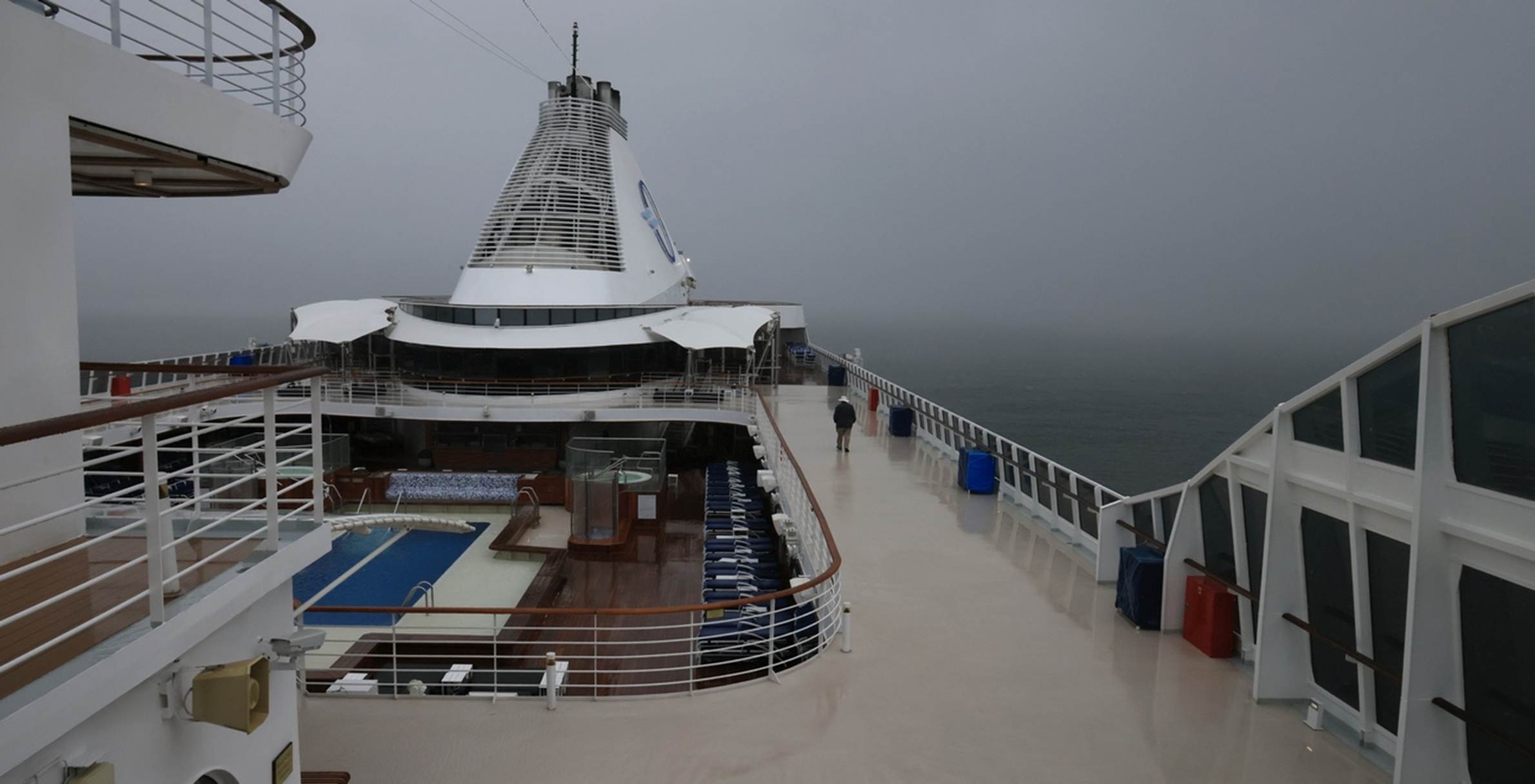
Some crazy person is out walking the deck in lousy weather.
Today the Marina was anchored in what could have been a fjord or, perhaps, just a area between some islands. The only excursion available was a touring catamaran trip down the fjord, through a passage into San Rafael Lagoon to view the San Rafael Glacier. What had started as just two offerings/trips of this excursion expanded into at least 5 trips. There was no other off-ship activity, so it was this excursion or sit on the ship all day. The schedule had been modified to allow the additional trips with the first trip leaving at 6:45 AM and the last one at something like 8:00 PM. We were far enough south that we had reasonable daylight from about 5 AM to 11 PM so all the trips would be in decent light.
We were initially scheduled for a 2:05 departure but it was changed to 2:45 and we finally actually left about 3:30 so I’m not sure what time the final trip got back. The trip was on a power catamaran that could probably accommodate about 125 passengers: it had a large enclosed passenger area and they did not allow anyone outside the cabin during the trip to the glacier or back. The Marina looked a little lonely as we pulled away and headed for the San Rafael Lagoon. You might get a little better feeling for it from this short video.

Quite a way from “home”, and going further
It was about a 75 minute ride to the glacier, first through the open bay, then through a fairly narrow channel that opened into the lagoon. There was not much to look at most of the time, until we started seeing some small chunks of ice, then larger chunks of ice.

What it looked like from inside the catamaran
When we cruised into the lagoon, some larger chunks of ice appeared that could actually be classed as icebergs. When you look at the iceberg below, remember that only about 10% of the ice is visible: most of it is underwater.

The first real iceberg we have seen
Soon, the San Rafael Glacier came into view, with a number of chunks of ice that had recently broken off of it. This is not the only glacier in the region. The glacier is within another Chilean National Park and is one of the larger glaciers, so the park and lagoon is named for it.
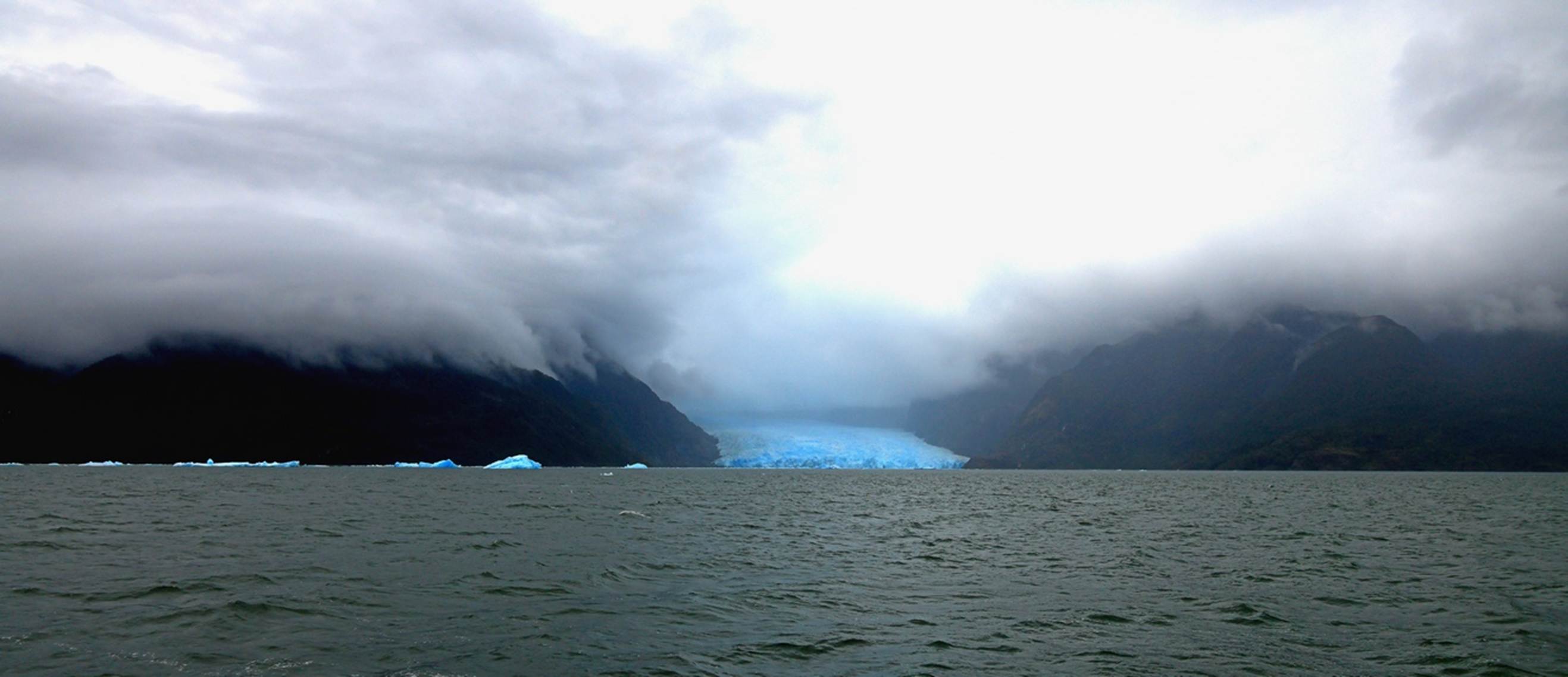
First view of the San Rafael Glacier
The tallest mountain in the southern Andes, Mount San Valentin, is in the park and is the source of four of the 19 glaciers within the park. In good weather, we would have seen several other glaciers from the Marina and the catamaran. When we got close to the glacier, the boat slowed down and we were allowed to go out onto the exterior decks to get better photos.

It looks more impressive up close.
The iceberg to the left of the glacier was probably “grounded” with the underwater part of the ice dragging on the bottom of the lagoon, preventing it from moving until it melts some.

As close as we could get: remember that most of the ice is actually underwater.
The ice in the visible glacier is several hundred feet thick and there is probably another 100 feet or more out of sight underwater. You don’t realize how big it is until you get close. The catamaran maneuvered around the glacier and in the lagoon for about 20 minutes, allowing us to get photos from different angles. After a good look, we had to go back inside, we said good-by to the glacier, and headed back to the ship.

Susan says good-by to San Rafael glacier
By the time we got back to Marina, it was about time to clean up and get ready for dinner in the GDR. After dinner it was time for another “Gilly and the Girl” show, this time featuring songs by Carol King and James Taylor and this time I had my camera to capture parts of the show. I think I set a record with this video and editing: something like 8 songs in a little over 5 minutes. Check it out.

Gilly (Mike) and the girl (Charity) doing Carol King and James Taylor
After the show we had a cognac (or two) in the Horizon Lounge listening to the Deuces dance band.
Saturday, Dec 27: Cruising the Chilean Fjords
Today and tomorrow, we will be “Cruising the Chilean Fjords”, although the long stay in the San Rafael area put us a bit behind schedule and we would actually be in the open Pacific Ocean until about noon. Because we were in the ocean, we were getting some decent waves and swells coming at us, rocking the boat a bit. It wasn’t bad, but a bit unpredictable because the larger swells were coming from one direction but the wind-blown waves were coming from a different direction. This also made the stabilizers a little less effective and you could tell that some people were uncomfortable: the little white bags appeared in various places on the ship for the people who might be in need of them.
When we got to the Terrace Café for breakfast, there was some commotion out on the exterior of the café, where it was too cold and damp to sit and eat. I went out to investigate and there were several large sea-birds, probably Albatross and Petrels, flying around the stern of the ship. Thankfully, I had my camera with me this morning.

This one looks like a Petrel.
Petrels and Albatross are somewhat related, are the biggest sea-birds in existence, and are both fairly common in southern Chile, the Patagonia region, and Antarctica. Their wingspans can stretch over 10 feet and they can both fly for weeks at a time without stopping on dry land, although they may occasionally land on the water as they are fishing for food. They are amazing flyers and seem to be able to glide forever. Check this video of an Albatross gliding and count how many times it flaps its wings.
After breakfast there was a presentation in the “Oceania Enrichment Series” in the Marina Lounge. I should explain that we had with us five scientists and/or other experts in things related to Antarctica and these experts gave presentations, typically one or two a day, starting on this day and through the next 10 days. The talk today was about “Brent Balchen: Polar Aviator”, a pilot who explored both poles by air, supporting some of the better known explorers. The speaker, Bryan Linton, a “Antarctica Historian”, made a potentially very dry topic surprisingly interesting.
Once we left the Pacific behind and were actually within the fjords, we frequently stopped at a window or our veranda to watch the landscape pass by.

Typical scenery within the fjords: but how much is hidden?
It was a bit frustrating though, because the clouds were so low over the mountains that we could seldom see their tops. We had the feeling that there was much more to see, especially some beautiful snow covered mountain tops, but they were all covered and hidden by the clouds. Our primary afternoon activity today was a wine tasting that was titled “A Journey Through Chilean Terroirs”.
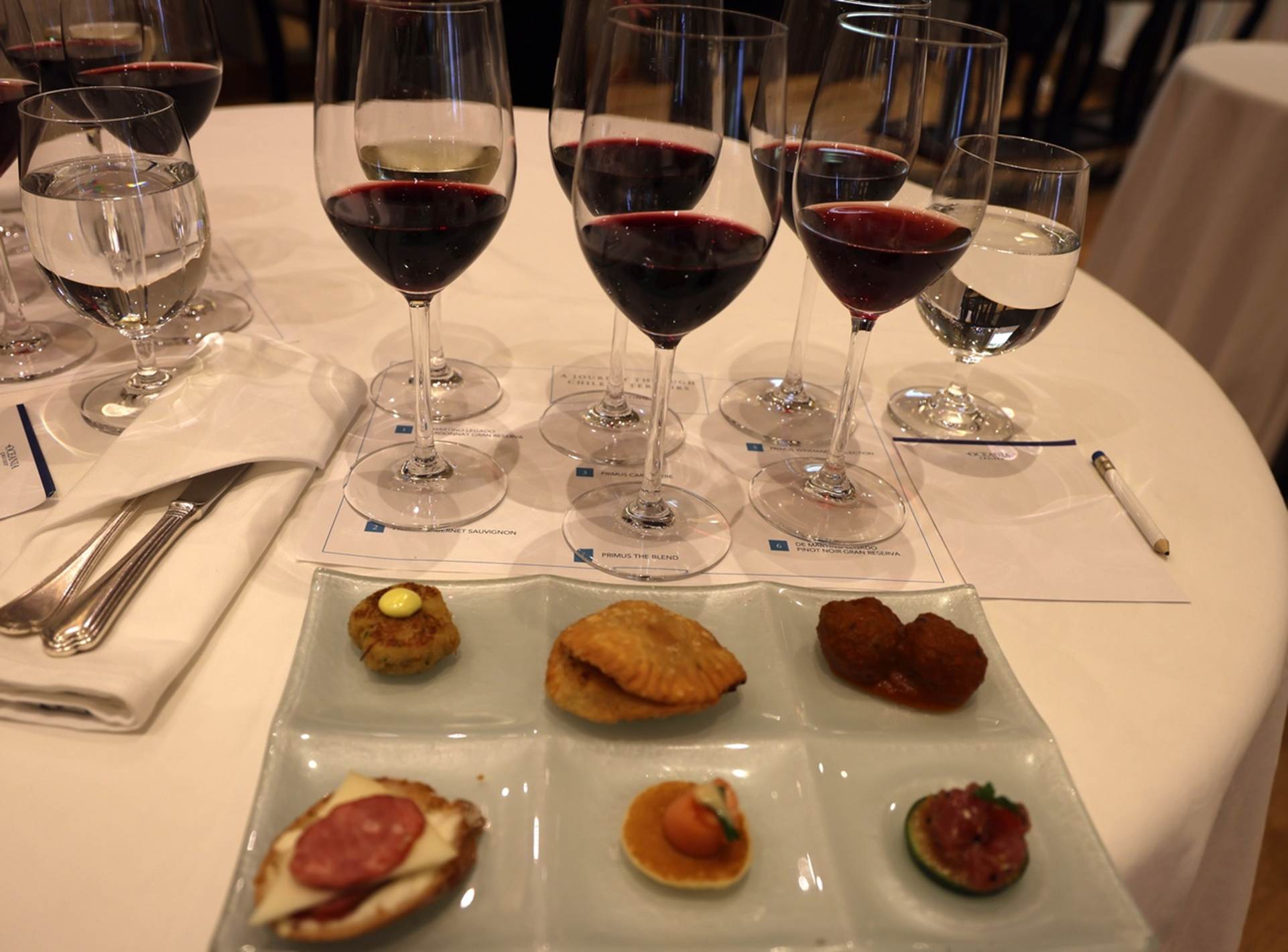
Six samples of wine and six small bites of food
While the tasting wines and food were nice, I really don’t think they fulfilled the title or purpose of the tasting. Four of the wines were from the same winery (and terroir) and the other two wines were from one other winery: hardly a sampling of terroirs across Chile. Since we had spent six days in Chile earlier the same year, tasting wines from probably 10 wineries and many terroirs, I was a bit disappointed in the chosen wines for this tasting. It seemed to be more of a marketing/sales presentation for wines that were available for sale on the ship.

A nice display of the wines: four from Primus and two from De Martino
The tasting did provide very generous pours of wine and plenty of food to accompany the wine so we had to rest a while to recover. We watched the shoreline roll by for a while, enjoying what sights we could see.

A small waterfall coming down the side of a mountain.
Dinner this evening was in the Red Ginger where the server offered an interesting sounding special of the day so Susan and I both selected it.. I don’t remember what the special was: I just remember that it was very non-memorable with a surprising lack of any distinctive flavor. The primary entertainment tonight featured the Marina Production Company, backed up by the Show Band, in a show called “Rocking Soul”. It was a pretty good show with lots of dancing and singing, but it seemed like they were sometimes working too hard at looking like they were having fun so it looked a bit “mechanical”.
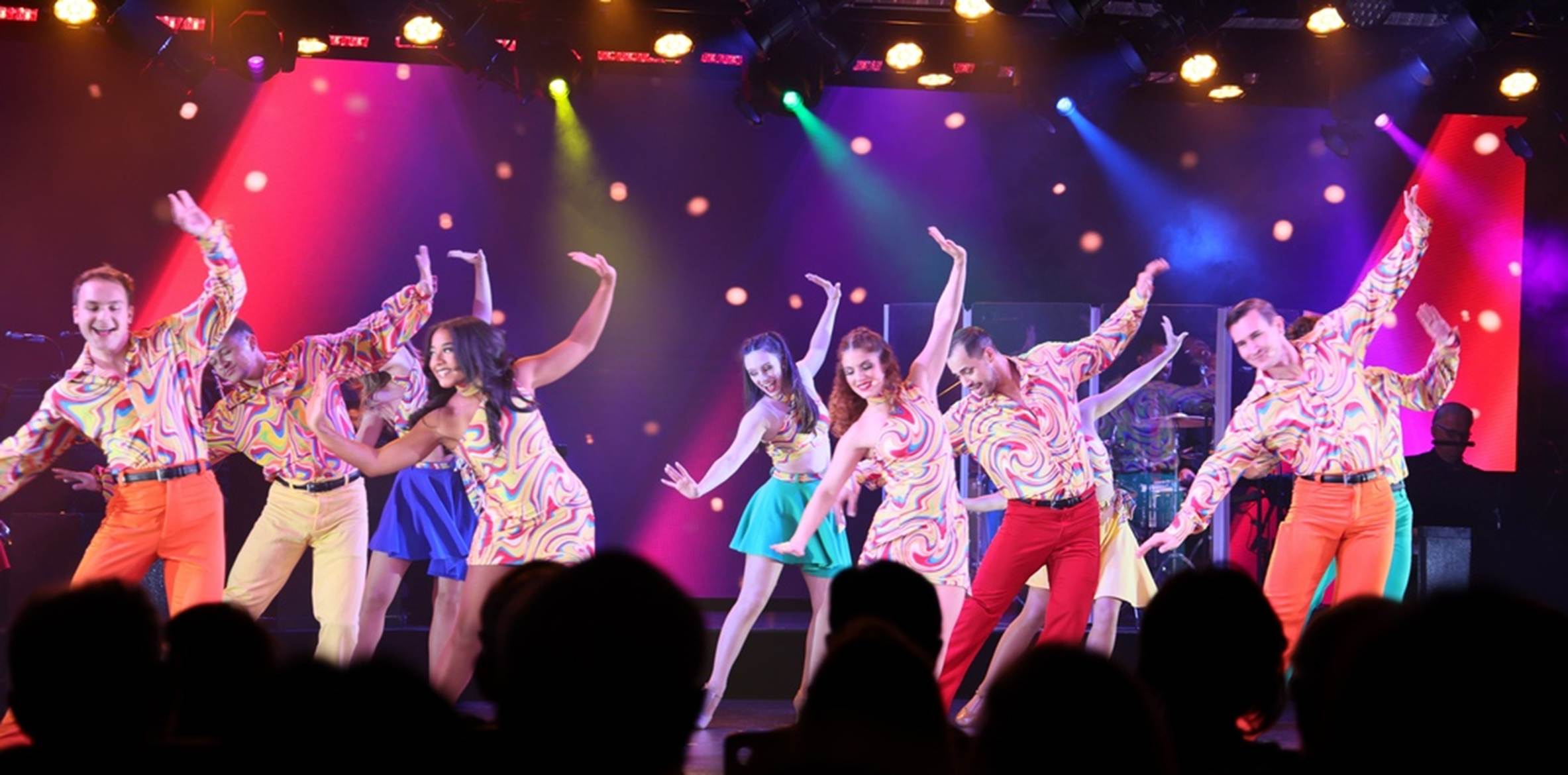
The full Production Company on stage
Sunday, Dec 28: Cruising the Chilean Fjords (again)
Once again there was some excitement at the stern as Susan and I entered the Terrace Café for breakfast. This time everyone was watching as the Marina navigated through a relatively narrow channel between two islands.
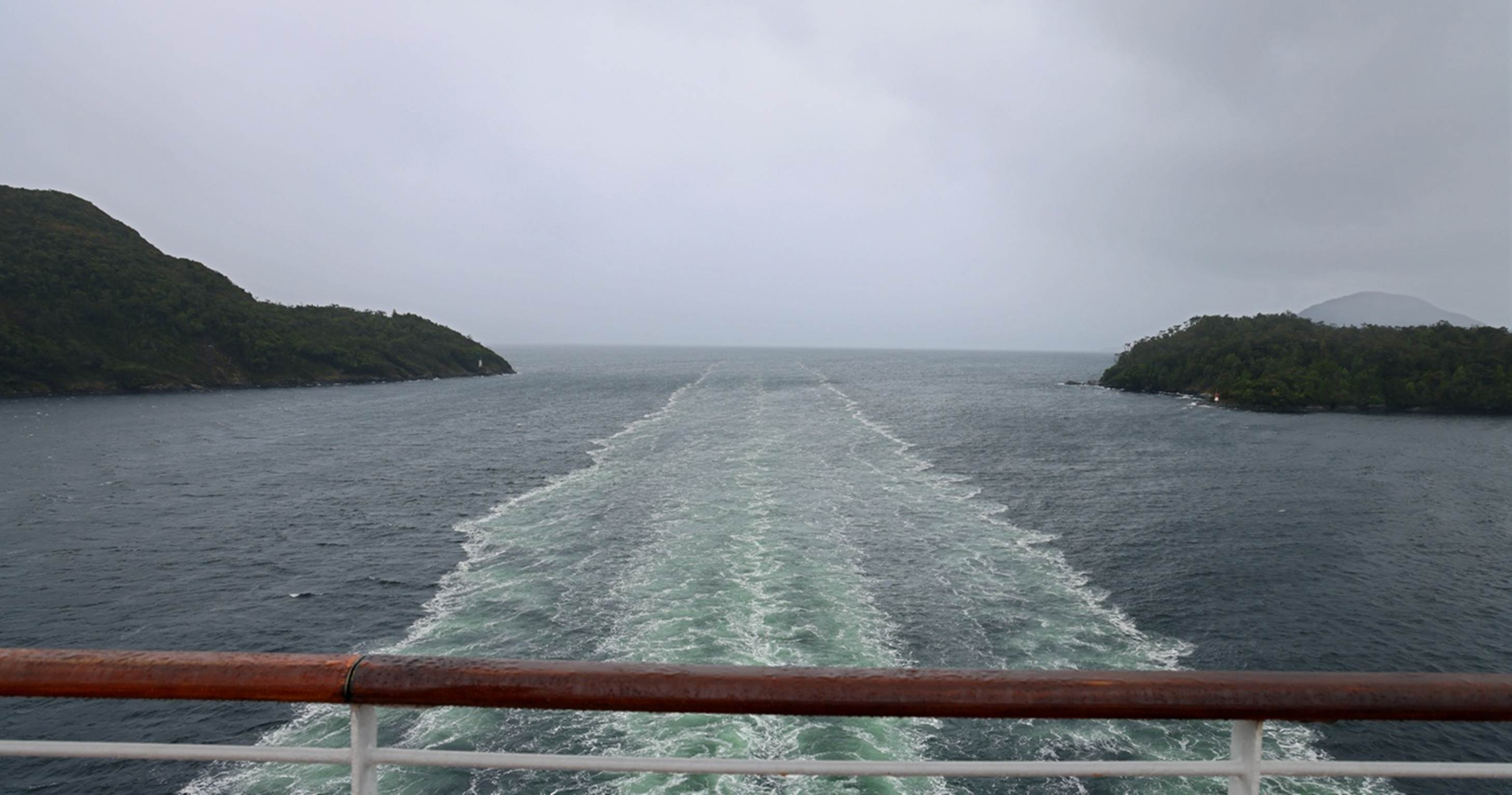
Going through a narrow gap
It doesn’t look too bad from the above photo, but a short video might be more interesting. We were now in the Magellan Strait, a somewhat winding route among the many islands at the very southern tip of South America. Although this route is longer and slower than going around the tip and through Drakes Passage, it is much less susceptible to the bad weather and big waves of the passage, so many ships will take an extra day or so to get the calmer waters. Of course, such a route has its own dangers, which we will see evidence of later today.
The weather has improved a little bit and we can see further into the distance. We still can’t see any of the higher mountain tops.

We can see a little further today and we have some islands.
Our main activity this morning is another culinary class and today our chef has prepared a nice Ceviche for each of us to munch on (and a glass of wine to sip) while he demonstrates how to properly pan fry a flank steak. As usual, much of the preparation has been done for us, including breading the steak and preparing a salsa to accompany the steak.

Back to Culinary class
I’m not a big fan of pan fried steak, but I thought mine came out reasonably well. It must not have been too bad: I managed to eat almost all of it before the class was over.

First dish today: my finished pan fried flank steak
While in the Culinary Center, we passed by one area where the clouds lifted enough to almost see the mountain top: we could just see a little snow and ice at the top.

We can almost see the mountain top!
To provide a little better idea of what going through the fjords and the Magellan Strait were like, I recorded a couple of time lapse videos and put them together in one video. The first part is from the previous day in the fjords and the rest of it is today, mostly in the strait. Check out this combination time lapse video. Considering that transiting via the Magellan Strait avoided the chance of really rough seas, I was somewhat surprised that we did not see any other ships, cruise or cargo, going in either direction, while in the strait
In the afternoon there was another presentation in the enrichment series, this one titled “Fjords, icebergs, and Sea Ice”. It was an interesting look at the various kinds of sea ice and the effects it can have on land masses. About the time the presentation was over, there were several announcements that we would soon be passing by a major ship wreck, the SS Santa Lenore. The Santa Lenore was making a passage thgrough the Magellan Strait in 1968 when it hit a small island, got stuck, and eventually sank there. Such is the danger of the Magellan Strait.
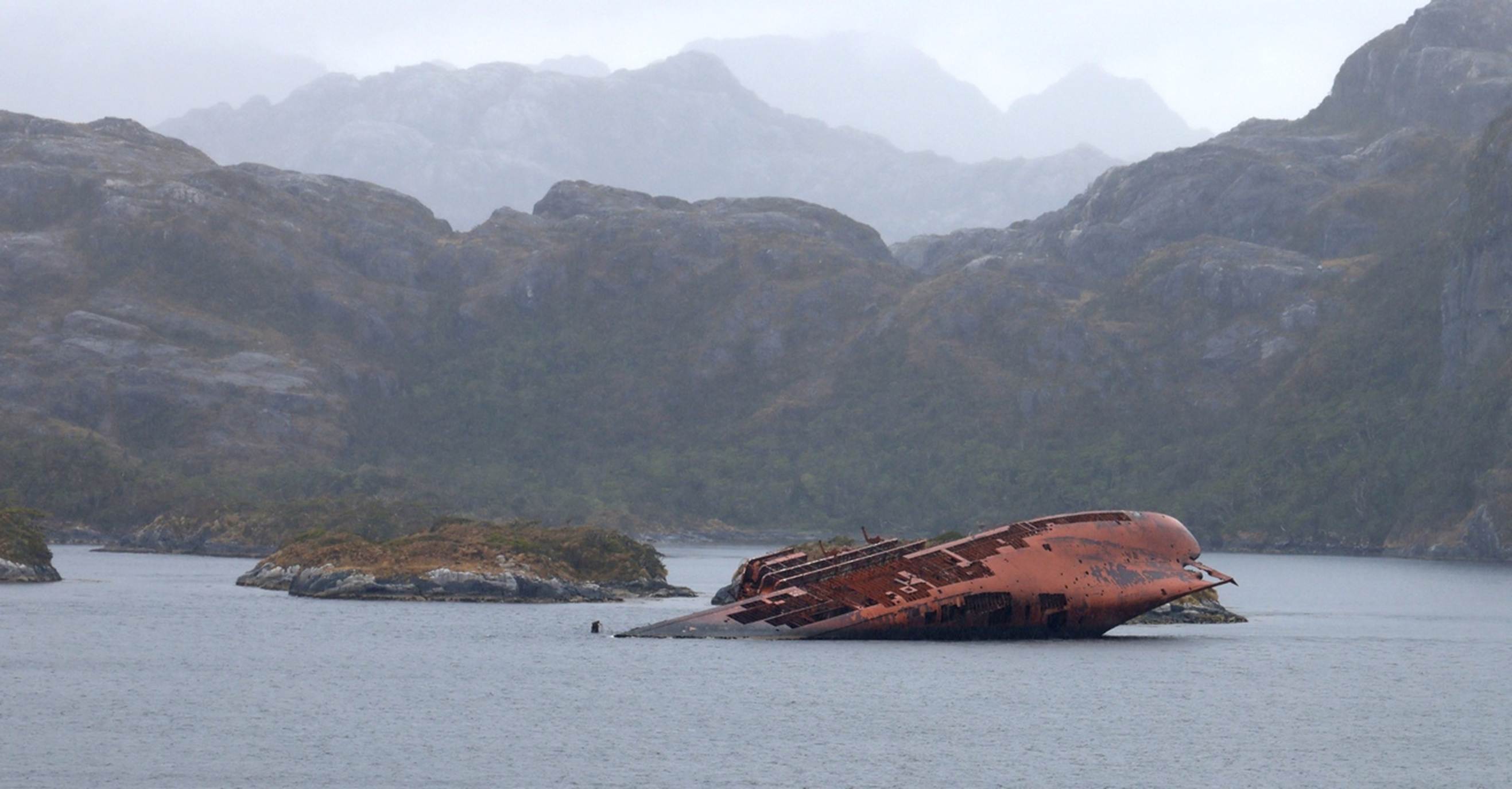
The SS Santa Lenora and the island it ran into
During the afternoon I had started to come down with a sore throat and stuffy nose. Unfortunately, this was the beginning of a relatively long-lasting illness that Susan, and many other people on the ship, also came down with. We decided that a simple meal of pizza would be a good idea and we had heard that the Waves Grill made decent pizzas, so we headed there for dinner. Waves has open air dining on the open deck and it was a little cool, but the wind screens and numerous heaters kept it reasonably comfortable. The main entertainment this evening was the string quartet doing songs from around the world. I normally don’t enjoy listening to a string quartet for very long, but they did a very good job mixing up the music and making it interesting: good job! After the show, we had one glass of cognac as purely medicinal purposes for my sore throat, then called it a night.
Monday, Dec 29: Punta Arenas, Chile
This morning, we were docked at a pier in front of the town of Punta Arenas. This is the primary Chilean city that is used as a jumping off point for expeditions and research trips to Antarctica and there were several such ships docked on the other side of the pier from us. The day was starting off as a clear and sunny day with little wind, which would be a very welcome change from the last few days.

A busy dock, with several Antarctica expedition/research ships
We were signed up for a Oceania excursion which would essentially be a sightseeing bus ride to another Chilean National park, this one with an old fort and then back to town and the ship. On the way to the National Park, the bus made a couple of sightseeing stops, including one at an overlook platform at the “Hill of the Cross” where we had a nice view of Punta Arenas and a large open area of the Magellan Strait.

The town of Punta Arenas from a small park with a good view
The strait is actually one of the main reasons the town was established: it was intended to help Chile control access to the strait. There were also some “friendly discussions” between Chile and Argentina as to just where the boundary between them would be so the town and the fort helped reinforce Chile’s claim to the area. Punta Arenas, the Magellan Strait, and the whole southern Patagonia area used to be much more important, but the opening of the Panama Canal reduced the ship traffic in the area to a small fraction of what it had been previously. Today, Punta Arenas lives mainly on fishing and support of cruise ships and research/excursion ships going to Antarctica.
After getting a short history lesson and a good look around and over the town, we got back on the bus for the ride to the Fort Bulnes, a little over an hour away. The fort was intended to be the primary way to enforce control over the Magellan Strait as it had a commanding view over this important part of the strait.

Entrance to the old fort
The fine print on the sign in the photo above says that the fort was initially opened on October 30, 1843 and it was “reconstructed” (renovated?) in 1943. Most of the “discussions” with Argentina took place around 1880 and, as you can see in the photo below, the fort would have been well defended from attack. I did not see any indication that there was ever a serious attempt to attack the fort, so I suspect that just its presence was enough to accomplish its objective.

The cannons had a good view over the Magellan Strait.
The cannons on display would have been very old, even in 1880, so I suspect more modern weapons would have been installed, especially during the World Wars, but these old ones look good and are rather immune to the bad weather.
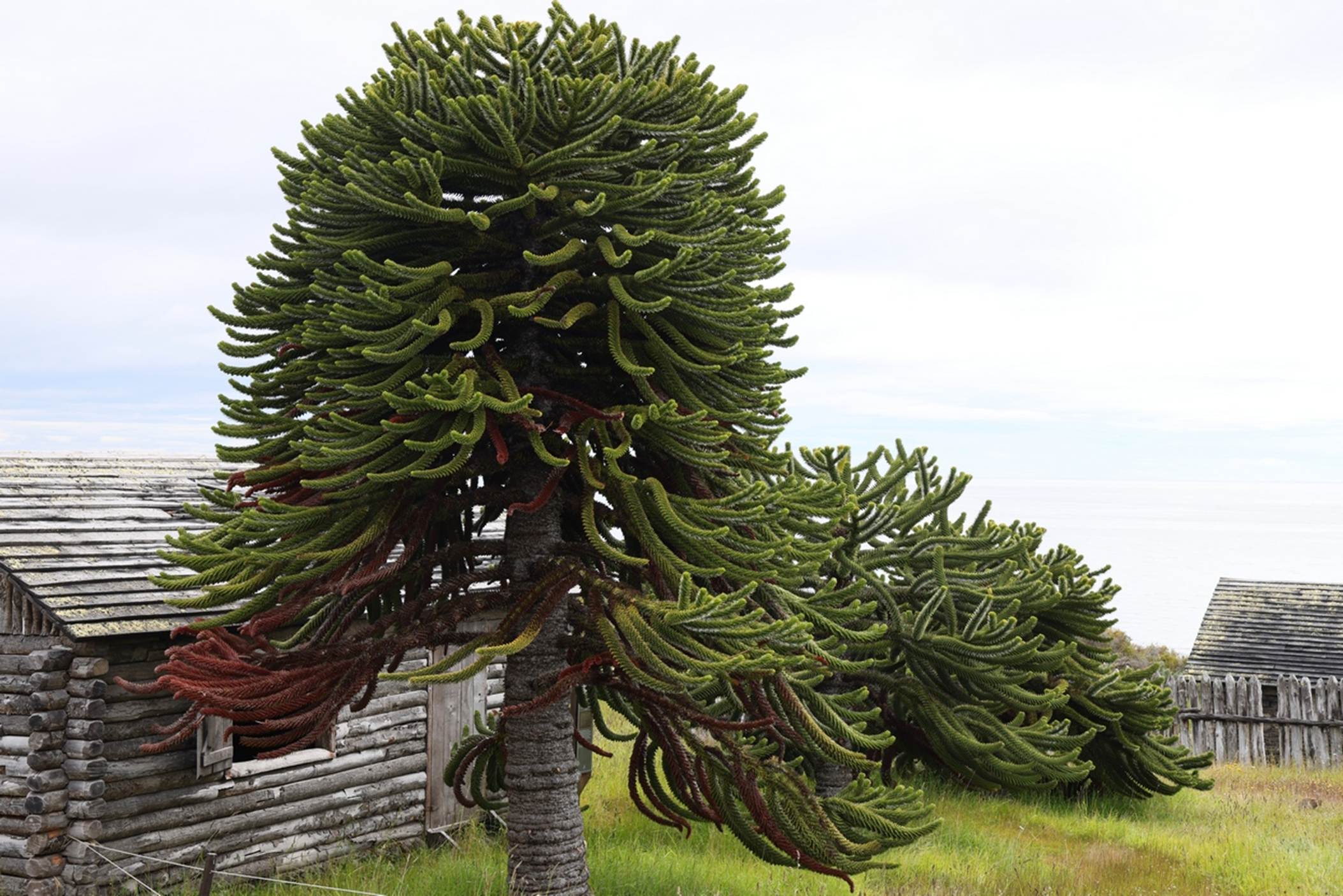
No idea what kind of tree this is
In walking around the fort and an adjacent park there were a number of unusual trees (above) and plants (below). I had to keep reminding myself that these were their summer blooms as this would have been equivalent to June in the northern hemisphere.

Some colorful summer plants were blooming.
Throughout the area, there were very few trees, especially larger, full grown ones and there turned out to be two reasons for this. When settlers initially came to the area in the early 1800s, ship building and repair was a major industry in support of commerce going through the strait. When the settlers came, there were a couple of types of trees that grew straight and had very hard wood. They had hard wood partly because they grew very slowly in this cold and frequently cloudy climate. All of the land for many miles around were stripped bare of trees for the ship building and, initially, there was no thought to plant replacement trees for later generations. There are now some reforestation efforts but, because the trees grow so slowly, it will take a long time to generate significant new forests.

Some of the relatively few normal trees
After looking around the fort and park area, we climbed back in the bus for the ride back to Punta Arenas and the Marina. By the time we got back, the clouds were rolling in and the wind was picking up. About 2:00, a light rain started but we were already back on board so we relaxed for the afternoon. I had not slept well the previous night because of my sore throat and congestion and a little extra relaxation was very welcome. Between the rest and some (purely medicinal) bourbon, my throat soon felt much better, although the congestion, frequent cough, and runny nose would continue for the rest of the cruise.
Dinner tonight was in the GDR, followed by cognac in Martinis bar and the third (and last) very enjoyable show by “Gilly and the Girl”. Tonight, and for the rest of the cruise, three pillows elevated my head enough to relieve most of the symptoms of my cold(?) and allowed me to sleep reasonably well.
Tuesday, Dec 30: Ushuaia Punta Arenas, Argentina
Ushuaia is essentially the Argentina equivalent of Punta Arenas, Chile: it is located on a strategic part of the Beagle Channel, which used to be an important route between the Atlantic and Pacific oceans, and is now an important jumping off point for ships going to Antarctica. With an international airport very close by, it tends to be preferred by cruise ships. On the day we visited, there was also a National Geographic expedition ship in port picking up a new load of passengers to head to Antarctica.
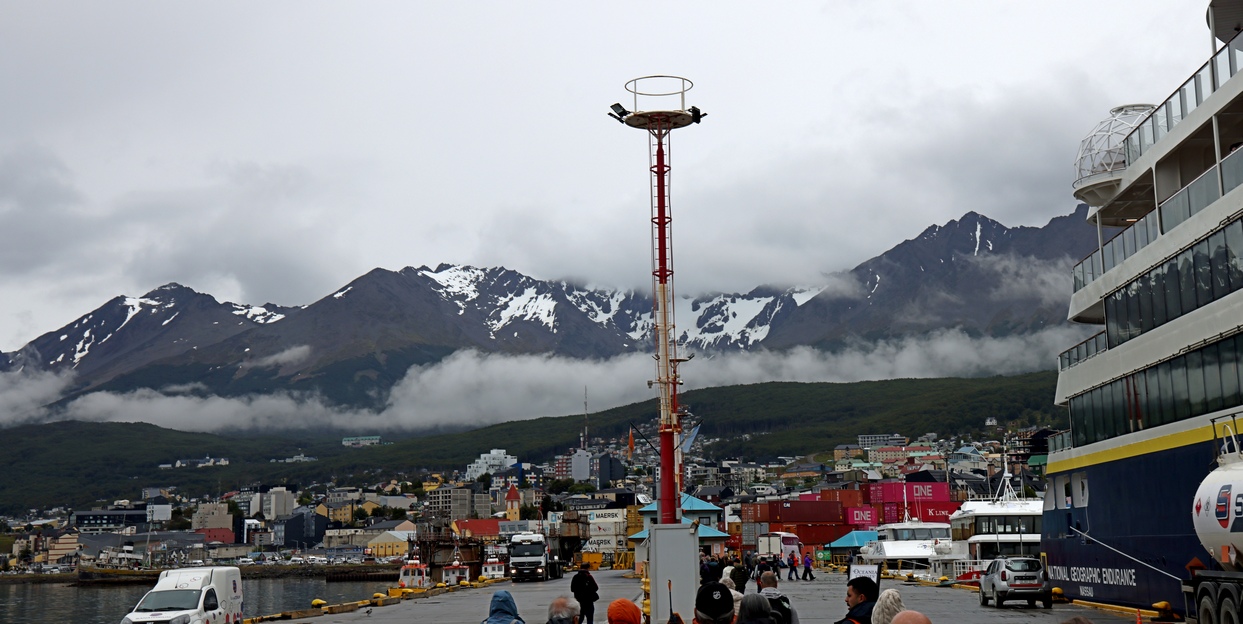
The Ushuaia dock was busy.
We had scheduled an excursion that would take us through part of the Beagle Channel and then go for a ride on the “Railroad to the end of the earth”. (More about the railroad a little later.) Our excursion group first walked a short distance down the dock to one of several catamarans docked there and we loaded on board, about 120 of us. We were soon off the dock and headed out into the channel.
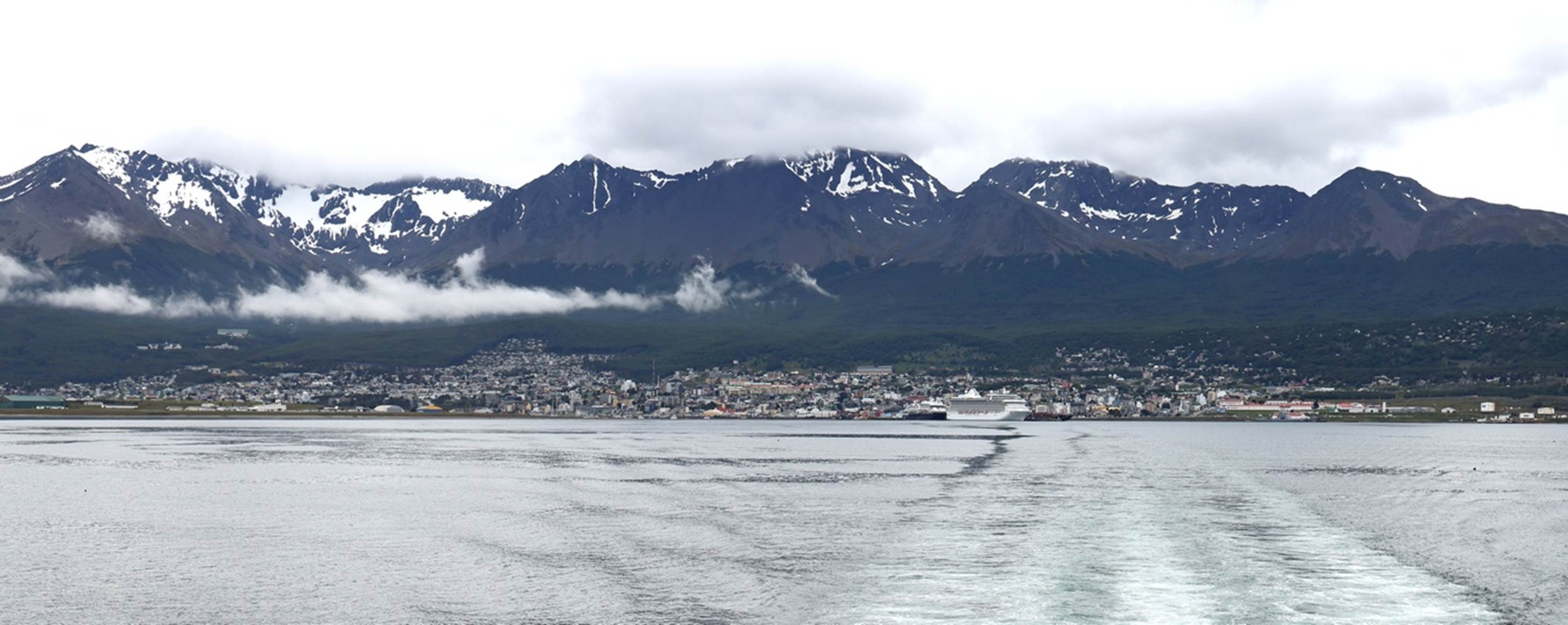
A view of Ushuaia from the Beagle Channel
As you can see above, Ushuaia is somewhat “scrunched up” between the waters and the mountains. While there is still a substantial fishing (and crabbing, as we will see) industry, tourism and the support of Antarctica research is now probably the bigger business in town.
We soon approached a small island with what appeared to be many black and white dots on it. As we got closer, the dots resolved into penguins, lots and lots of Gentoo Penguins. They would crowd into a few areas of the island, leaving other parts that looked the same, completely empty.

A few penguins on a small island in the channel
The boat maneuvered around the island for a couple of minutes, giving everyone a good view of the penguins, then headed over toward another island which had a lighthouse on it. It turned out that the lighthouse was not the only thing on the island. Look closely at the rocks close to the water in the photo below.
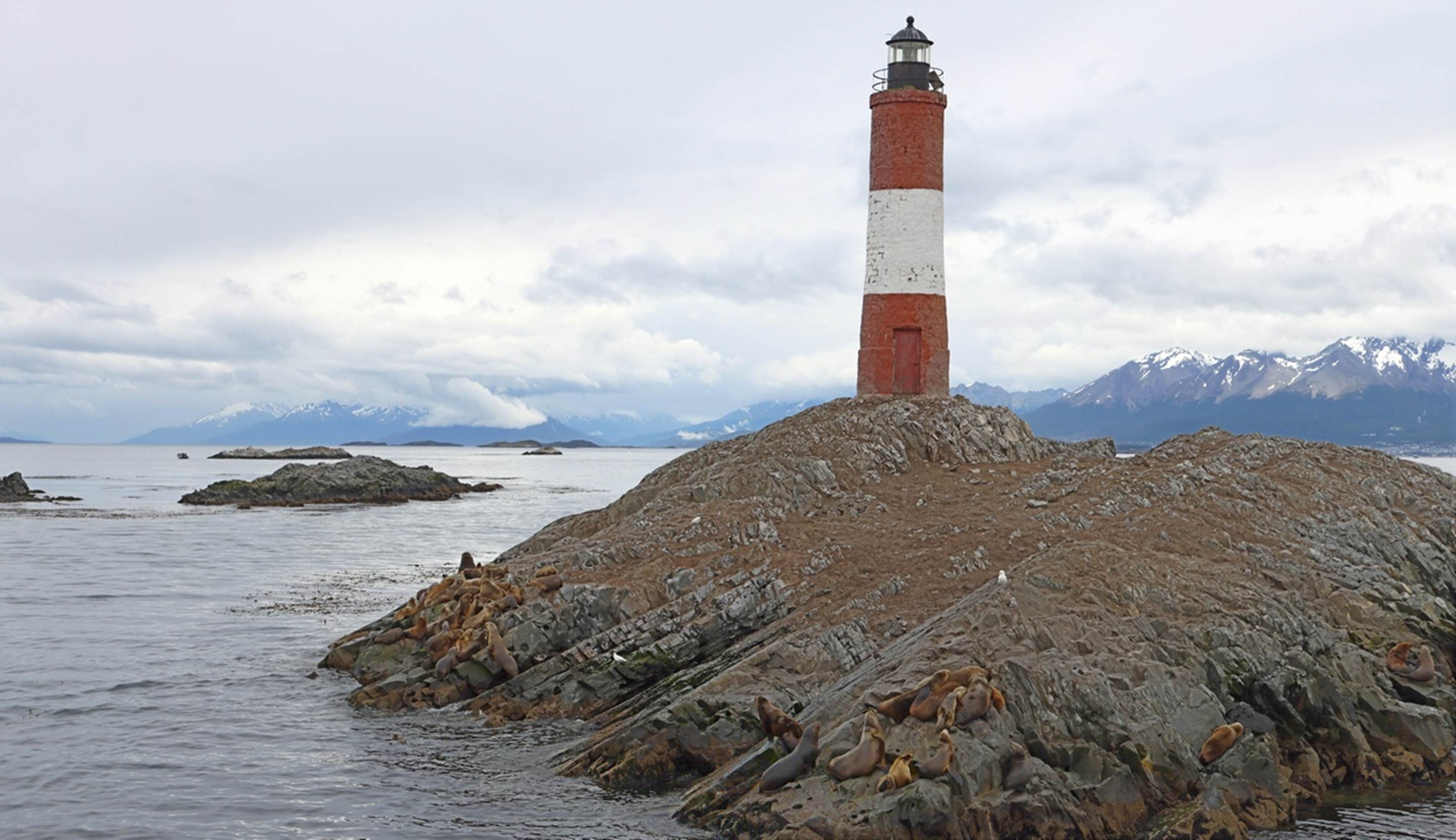
A picturesque lighthouse, but look carefully among the rocks.
These are “South American Sea Lions” and, like the penguins, they have staked out a specific island for their use. No other island in this area has any significant number of Sea Lions.

Not seals, but South American Sea Lions
Again, the boat cruised around the island slowly to give everyone a look, then headed over to another island a short distance away.

And another Penguin Island
And this was another island that penguins had claimed. We did not see any penguins on the sea lion island or vice versa: some islands had penguins, some had sea lions, some had neither, but no island had both penguins and sea lions. After a good look at these penguins, we headed further down the channel, taking note of the impressive views as we cruised aloing.

Another view of Ushuaia and its mountain backdrop
We noticed a small “fishing boat” ahead of us and our captain pulled up alongside of the colorful boat and sailor. It didn’t look like any kind of fishing boat I was familiar with, but since I really don’t know much about fishing in these waters, I didn’t say anything to show my ignorance.

A colorful crabber and his boat
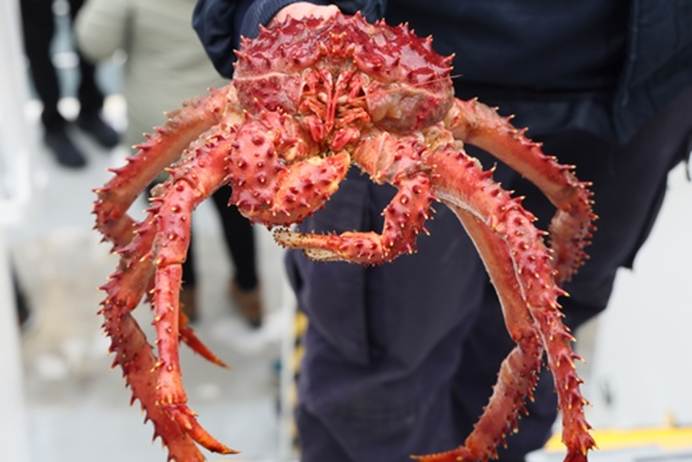
A couple of the crew from our catamaran went down to the level of the other boat and came back with crabs! Not just any little crabs, but King Crabs! One crewman had one huge crab and another crewman had two slightly smaller ones to show around while the “crabber” cranked up his boat and Putt-Putted away. Most likely our captain was going to have King Crab for supper tonight because, as we found out later, he and the crabber are brothers.

A King Crab from the crab boat
We cruised along the Beagle Channel for about another half hour, then arrived at a rather makeshift dock and gangway where we disembarked.

Transferring to land and a bus at Bahia Lapataia
This point of land is called Bahia Lapataia and, once we got off the catamaran, there were more groups of people doing essentially the same excursion in the other direction. Once on land, we climbed into one of 4 or 5 busses, depending on which group number we were on. Our bus soon pulled away and took us to a small park and beach on a lake, Lago Roca. None of us were sure what we were supposed to do at the lake, but I suspect that in better weather we would have had a spactular view of the multiple snow-capped mountains around the lake.
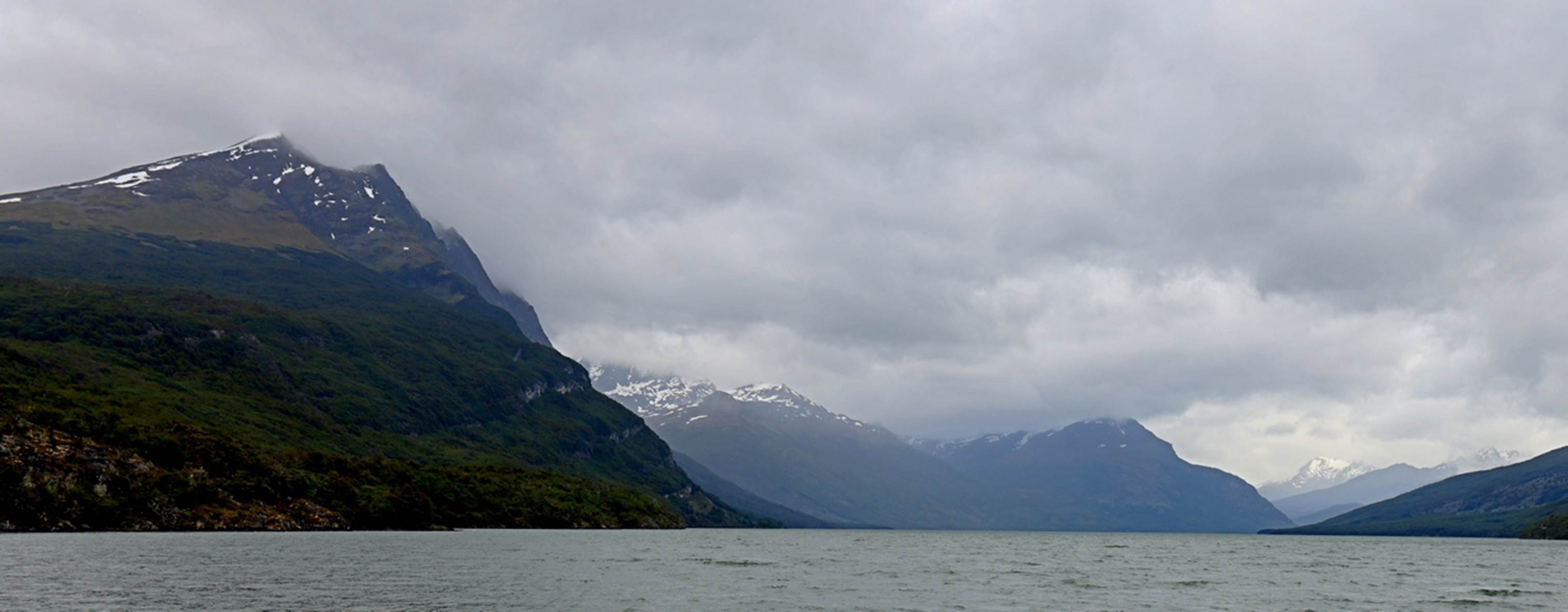
Probably a beautiful scene of Lago Roca in clear weather
In doing my research for this report, I realized that the Argentina/Chile border crosses the lake about a mile from where we were standing at the beach. After enjoying the less than fabulous view for a few minutes, we climbed back in the bus for a short ride to the train station.
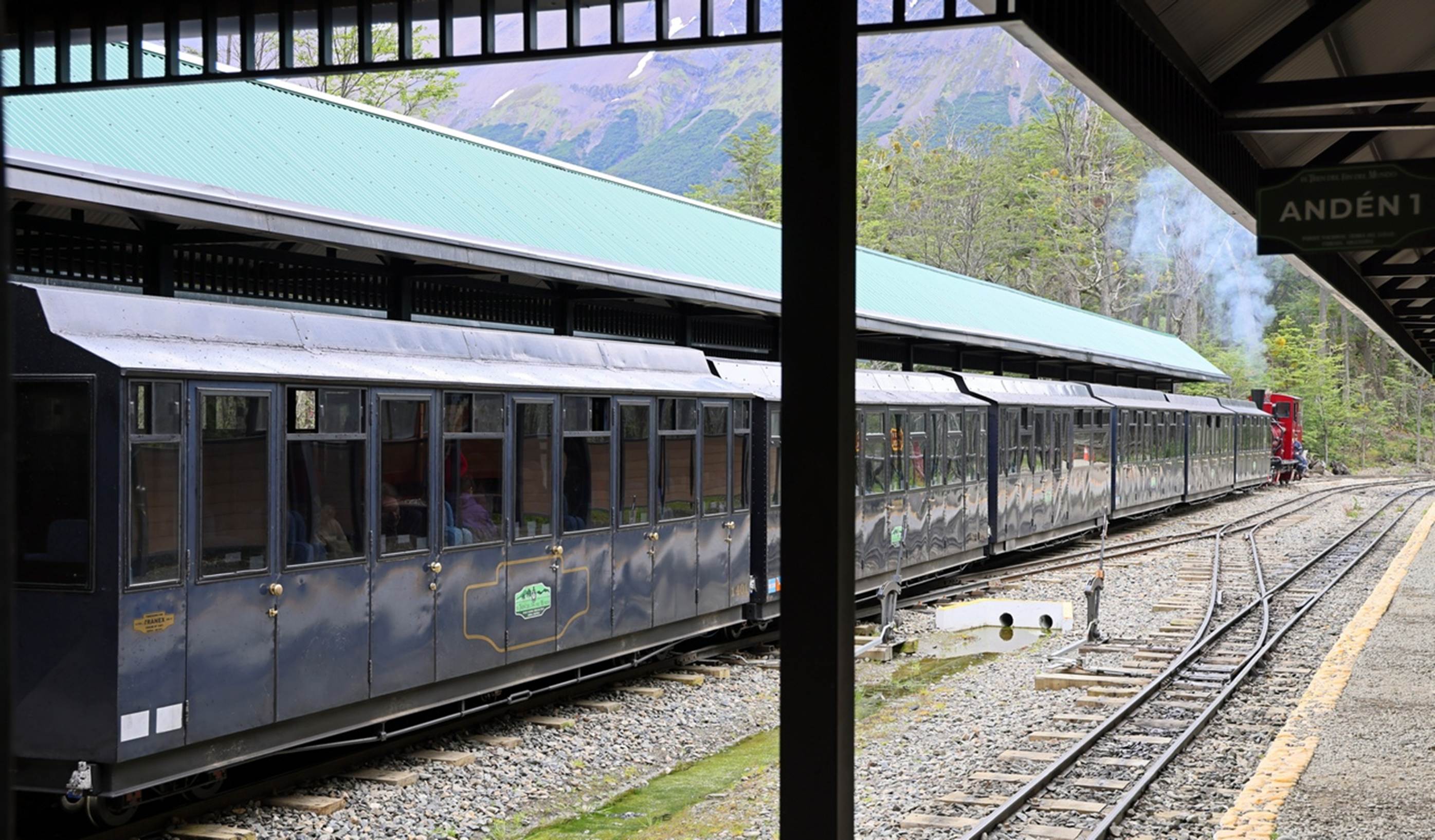
The prison end of the “Railroad to the end of the Earth”
This deserves a little explanation….. Around 1910 a prison was being built about 10 miles south from Ushuaia. It was so far south that people started referring to it as “The end of the earth” because there was literally nothing beyond it. To aid in the construction of the prison (it was to be a large one) the prisoners first built a narrow-gauge railroad to haul the building materials from Ushuaia to the prison. When the prison was completed, the railroad continued in use to supply the prison with food and other staples, take new prisoners to their new home, and to shuffle guards back and forth. The prison was closed in 1947 and the train fell into disrepair for many years but was renovated in the early 2000s as the tourist trade started to transform Ushuaia to its new form. Today the train, using the same locomotives and passenger cars built to the same basic design as the origionals, shuffles thousands of tourists back and forth between Ushuaia and “The end of the earth”.
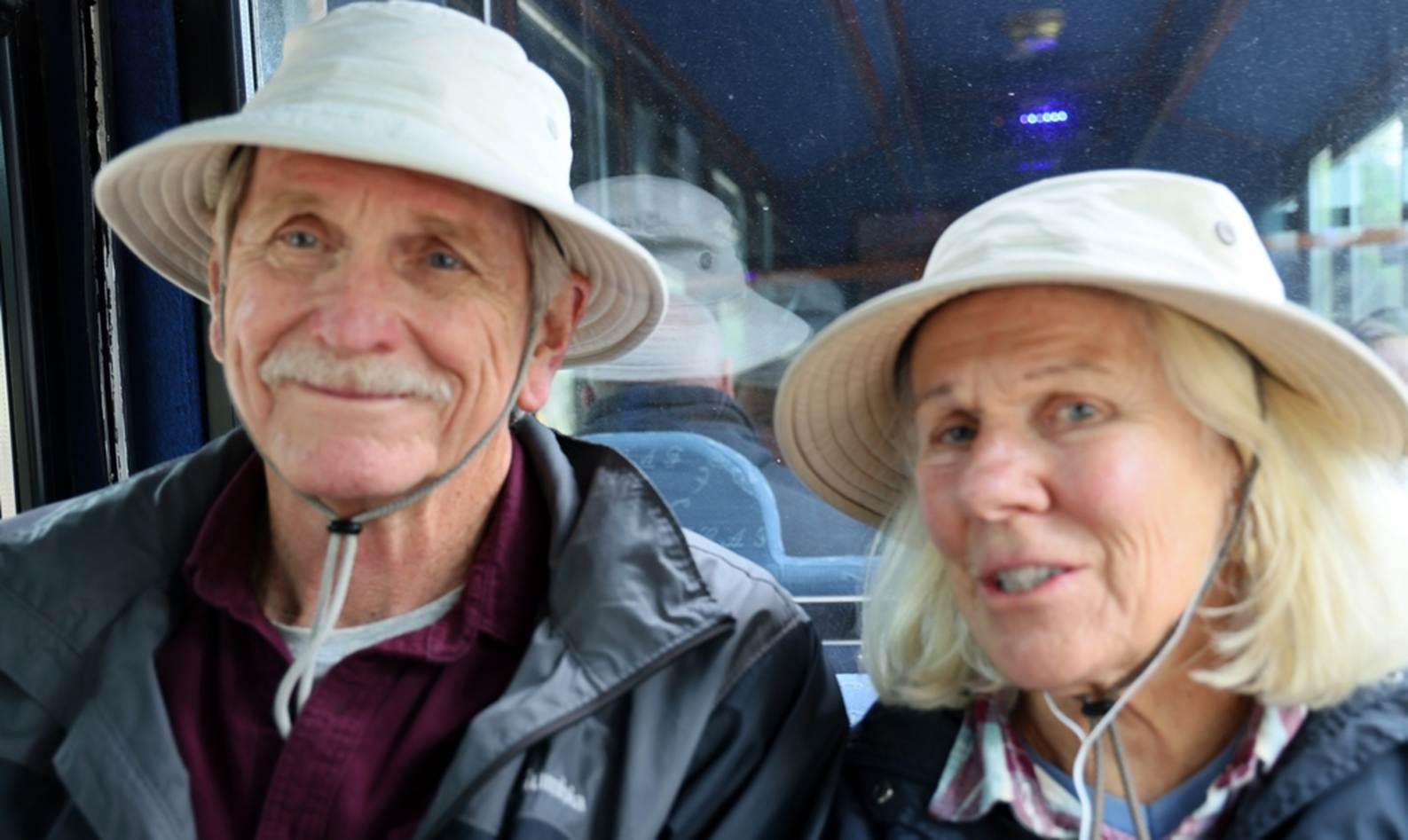
Certainly looks like a couple of questionable characters
The bus dropped us off at the station pictured above where we found seats in the narrow and rather drafty passenger cars. When the train started moving, it was surprisingly smooth and quiet: steam power will do that. We rode at a fairly slow pace, perhaps 20 MPH maximum, for about 6 or 7 miles then stopped at a wide area with multiple sets of tracks and another train headed in the other direction on an adjoining track.

The steam locomotive at the front of the train
When I checked out the locomotive, I realized that this was a water station to refill the water tank for making steam. We were there for almost 30 minutes, probably long enough to refill the tank and then get up a fresh head of steam. With a couple of blasts of the whistle, everyone climbed back on and we rolled on about another 2 miles to the train station at the Ushuaia end of the tracks.

Taking a break at the water station
At the train station, we boarded our bus again and made the 20 minute ride back to the Ushuaia dock and the Marina.
If you think that you really didn’t get a good feel for the various sights and activities on this excursion, I have something new for you, a combined video and slide show with some sights you didn’t see in the photos above. Even if you haven’t looked at any of the other videos in this report, you should check this one out.
We relaxed the rest of the day and I think Susan did some laps around the upper deck of the ship for a little exercise: I wasn’t feeling up to that. We got cleaned up in time for a glass of wine in Martinis bar before our reservation at the French themed restaurant, Jacques. I’m usually not a big fan of French cuisine, but I was able to find several items that tasted reasonably good, even with my reduced sense of taste. The show by the production company sounded interesting, but I was having occasional uncontrolled bouts of coughing and thought this might not be appreciated in a crowded theater type lounge so we just enjoyed a couple of classes of cognac and called it a night.
You can either click on the “Back Button” to go back to the main page, or click on:
Chapter 4 - the cruise continues